


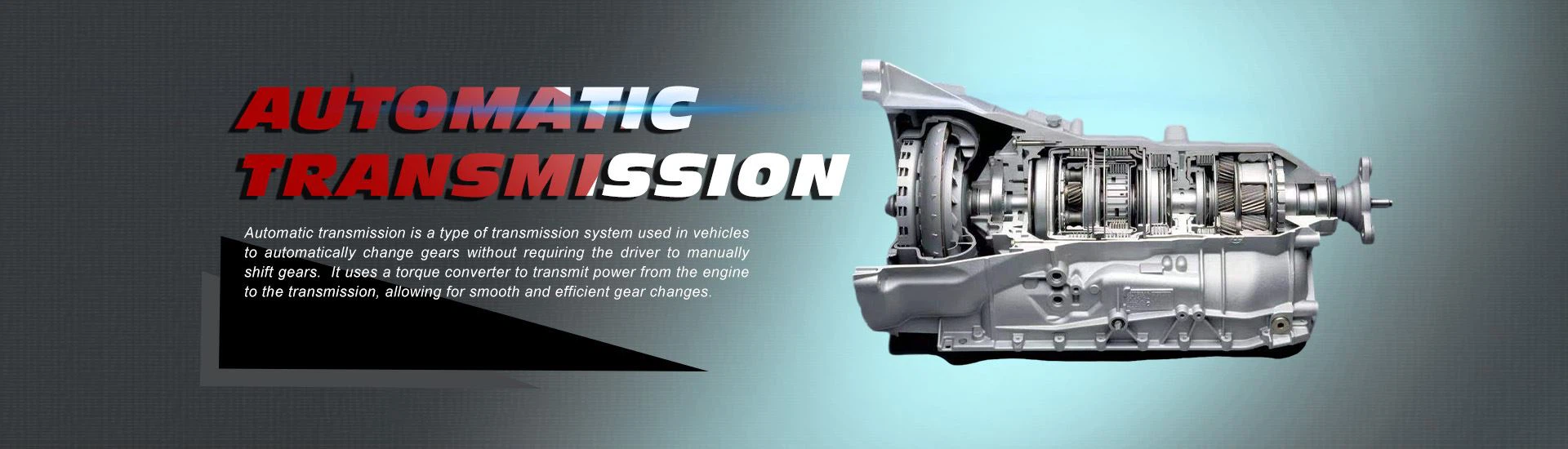
With a hydraulic torque converter, the structure is simple, there is a turbine connected transmission input shaft, the pump wheel (the converter housing) is connected to the engine flywheel, and between the two there is a guide wheel (to play the role of low-speed torque increase). There is a locking clutch grinding disc between the turbine and the housing, which can work at high speeds to reduce the power loss of the engine.
The gearbox has fewer external accessories, including gear switches, heat sinks, as well as solenoid valves and sensor plugs (small for input/output and oil temperature sensors, large for individual solenoid valves). In some models, due to the space in front of the gearbox, the sensor external wiring harness plug is easy to break, resulting in instrument prompt failure and lock.
The hydraulic body is installed in the lowest oil pan and contains multiple solenoid valves for transmission system oil pressure control and shift oil pressure control.
The transmission pump is used to establish the entire oil pressure, which is directly driven by the engine. Since this pressure is much higher than the pressure required by the transmission itself, the pressure established by the oil pump will be adjusted by the pressure regulator for the normal operation of the transmission.
The actuator inside the case contains 5 sets of clutches, including 3 sets of clutches and 2 sets of brakes. KI clutch operates in 1234 gear, clutch clearance is 1.0mm, too small clearance will lead to gear impact.
The clutch K3 operates in 35R gear with 1.0mm clearance.
The clutch K2 operates in the high speed 456 gear with 1.0mm clearance. And the K2 clutch external also acts as the signal plate for the input speed sensor, because it is directly splined with the input shaft.
Brake B1 operates in gears 2 and 6 and is mounted outside the k3 clutch because the k3 clutch housing is connected to the sun wheel of the bottom planetary row by a bracket. Its function is to secure and lock the sun wheel.
Brake B2, acting in R and manual 1, also known as the low reverse brake, its role is to fix the planetary frame. It is installed on the lowest part of the gearbox housing, and starts to work after pressurizing the oil, so that the planetary frame and the gearbox housing are consistent and do not move.
Another important component of the gearbox, the one-way clutch F, is attached to the bottom planetary frame outside, above the low reverse brake. Same as the low reverse brake B2, which acts on the bottom planetary frame. But the brake is to fix the planetary frame, so that it can not rotate forward and backward. The one-way clutch is just to prevent it from reversing, and in the normal operation of the whole gearbox, to ensure that the planetary frame will not reverse, otherwise the forward gear will not have power output.
The working time of the complete set of gear shifting actuator is shown in the following table
| unit | ||||||
| Gear position | K1 | K2 | K3 | B1 | B2 | F |
| Gear 1 | ⊙ | ● | ⊙ | |||
|
Gear 2 |
⊙ | ⊙ | ||||
| Gear 3 | ⊙ | ⊙ | ||||
| Gear 4 | ⊙ | ⊙ | ||||
| Gear 5 | ⊙ | ⊙ | ||||
| Gear 6 | ⊙ | ⊙ | ||||
| Gear R | ⊙ | ⊙ | ||||
Common problems: High temperature, because the external radiator is used for a long time, the internal scale is generated, the flow rate is reduced when the coolant passes through, and the heat of the transmission oil can not be taken away in time. The vehicle will not shift up or will shift up to 2nd gear at most. The continuous high temperature will burn the internal clutch disc, especially the k1 ancient.
Some of the high temperature alarm is also related to a long time of micro-slip in the gearbox, which is specifically manifested in the wear of the oil supply ring of some of the actuator components, resulting in cross-pressure, so that the clutch that should not work is still working in semi-linkage, so that the oil temperature rises quickly, and it is necessary to check the sealing oil ring specifically.Common problems: High temperature, because the external radiator is used for a long time, the internal scale is generated, the flow rate is reduced when the coolant passes through, and the heat of the transmission oil can not be taken away in time. The vehicle will not shift up or will shift up to 2nd gear at most. The continuous high temperature will burn the internal clutch disc, especially the k1 ancient.
Some of the high temperature alarm is also related to a long time of micro-slip in the gearbox, which is specifically manifested in the wear of the oil supply ring of some of the actuator components, resulting in cross-pressure, so that the clutch that should not work is still working in semi-linkage, so that the oil temperature rises quickly, and it is necessary to check the sealing oil ring specifically.
3 liter 4 gear slip or idling, this fault belongs to the transmission defect, due to the rubber main piston in the K2 clutch drum is broken, resulting in the piston pressure to enter the clutch.
Shift shock, delay, shift shock or delay, problems with the quality of various shifts on the road. Under the premise of ensuring the quality of internal maintenance, these faults are mostly related to the valve body, and the problem of impact and slip delay can be tried to solve by adjusting the corresponding solenoid valve, and the impact indicates that the oil pressure entering the actuator is larger and the delay is smaller
1, the oil pressure is too large (impact) For this situation, the oil pressure needs to be reduced to ensure that the shift is smooth; The method is also very simple, we need to turn the pressure regulator spring compression screw at the bottom of the solenoid valve clockwise at a certain Angle, so that the spring is more elastic, so that the oil pressure that needs to overcome the bottom of the pressure regulator will increase, and the oil pressure in the actuator will eventually decrease accordingly.
2, the oil pressure is small (slip delay) turn the screw counterclockwise to increase the oil pressure. However, many times it is because the impact caused by the small oil pressure is ignored, this time can not continue to reduce the oil pressure, but to increase the oil pressure. For example, 1 liter 2 obviously feels very slow, and there are a few signs of skidding at the moment of shifting, but it is accompanied by 3 drop 2 impact. This situation can not blindly think that the impact is caused by the large oil pressure, but because the oil pressure is not enough, it is necessary to adjust the corresponding solenoid valve oil pressure to solve the problem. To increase the oil pressure, the screw must be turned counterclockwise at a certain Angle, so that the spring release a short distance of the elasticity becomes smaller, so that the oil pressure to overcome this elasticity decreases, and then the oil pressure of the final actuator increases.
Related solenoid valve or sensor circuit electrical fault code, resulting in lock and instrument red screen problems, according to the fault guidelines, check the corresponding electrical components and related lines. The wire ends of the two plugs on the outside of the box are easy to break.
It is easy to report the fault code on Pentium car, p0999 shift solenoid valve SLB1 control line, short circuit or related sl,slc,slb1,slc1 and other faults, you can repair the computer.


